
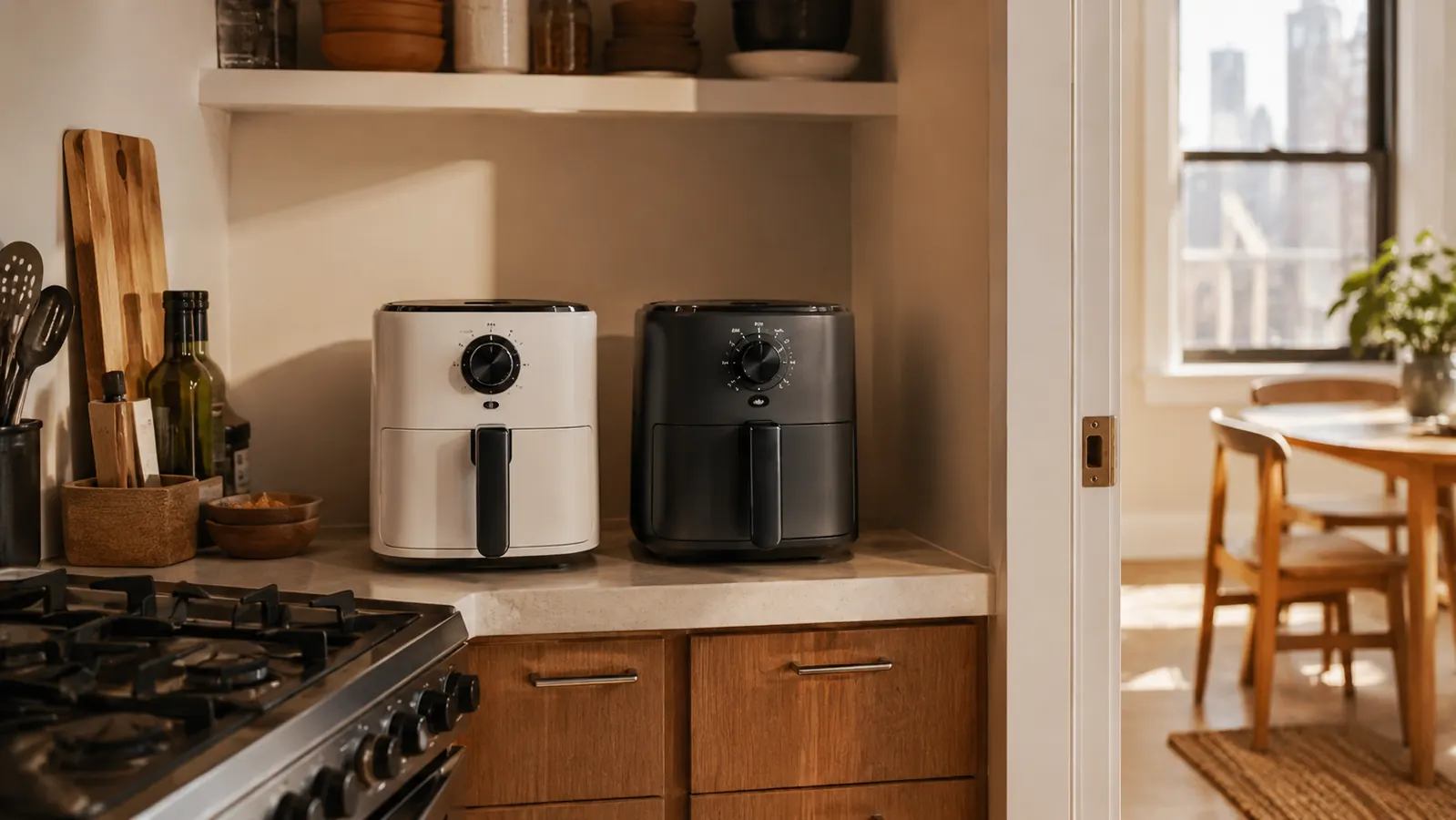
If you've spent any time comparing air fryers for a small kitchen, you've probably landed on the same shortlist I did: the Dash Tasti-Crisp 2.6-quart and one of Ninja's compact models. And if you're like me, you've wondered whether it's worth spending twice as much on the Ninja for features you're not sure you'll actually use. I had a 24-inch stretch of counter in my old apartment. Every appliance had to earn its spot. What I learned after testing both is that the Ninja's extra features are real, but they're solving a problem I don't have. If you're cooking for one or two people, reheating leftovers, and crisping up frozen veggies on a Tuesday night, the Dash does everything you need for a fraction of the price.
That said, the Ninja is not a bad machine. There are situations where it genuinely makes more sense. I'll walk you through both so you can land on the right answer for your actual kitchen, not just the one that looks best in a roundup.
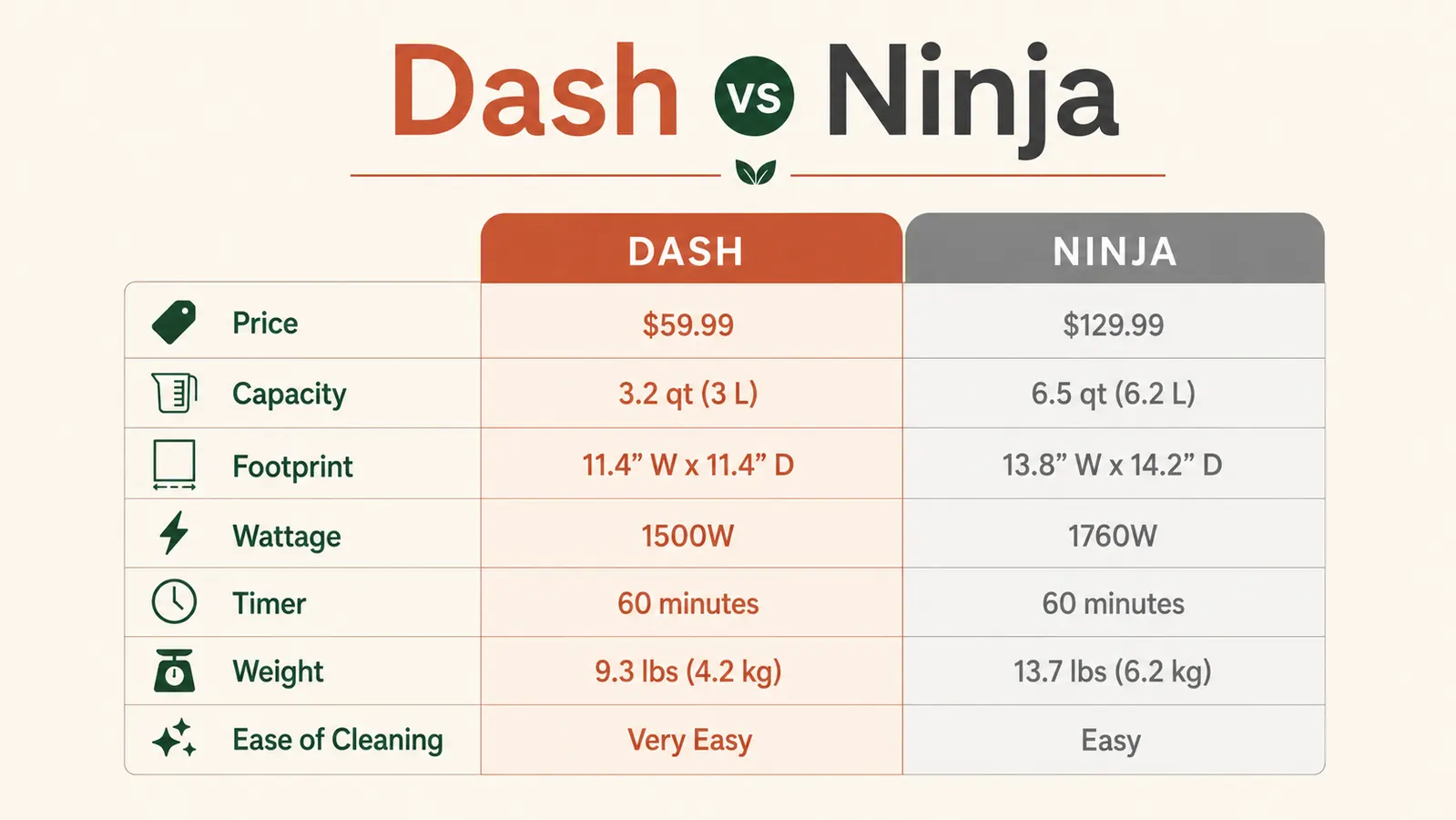
| Dash Air Fryer | Ninja | |
|---|---|---|
| Price | Check today's price on Amazon | Check today's price on Amazon |
| Capacity | 2.6 quarts | 4 quarts |
| Counter Footprint | 8.5" x 8.5" x 10" | 9.8" x 11.8" x 13.1" |
| Wattage | 1000 watts | 1550 watts |
| Temperature Range | 250F to 400F | 105F to 400F |
| Timer | 30-minute manual dial | 60-minute digital timer |
| Weight | 2.9 lbs | 6.2 lbs |
| Ease of Cleanup | Dishwasher-safe basket, one part | Dishwasher-safe basket, one part |
| Preheat Required | No, ready immediately | Yes, adds 2-3 minutes |
Where the Dash Wins
Price is the obvious one, so let me get it out of the way fast: the Dash costs roughly half what the Ninja costs. For a lot of households, that's the whole conversation. But even if money weren't the issue, the Dash earns its spot for a few other reasons that matter in a small kitchen.
The footprint is genuinely small. At about 8.5 inches square, the Dash sits between my coffee maker and the wall with room to spare. The Ninja is noticeably wider and taller. That might not matter if you have a big kitchen, but when you're working with limited counter space, a few extra inches in every direction starts to feel like a lot. I've seen people put the Ninja on a rolling cart just to have somewhere to put it. The Dash just lives on the counter.
Cleanup is dead simple. There's one basket, it pops out, and it goes in the dishwasher. No accessories to keep track of, no crisper plate to scrub separately. After cooking frozen fries or chicken strips for the kids, I can have the basket in the dishwasher in about 90 seconds. That matters on a school night when dinner and cleanup are already competing with homework and baths.
The weight difference is also worth calling out. The Dash weighs under 3 pounds. The Ninja is over 6. If you ever store your air fryer in a cabinet and pull it out when you need it, you'll notice this every single time. The Dash is light enough that my teenagers can grab it without anyone losing a finger.
The Dash 2.6-Qt Does 90% of What the Ninja Does at Half the Price, and Here's Why That Math Wins in a Small Kitchen
The Dash Tasti-Crisp 2.6-quart has over 34,000 Amazon ratings and sits at 4.5 stars. It's one of the bestselling compact air fryers for a reason. Check today's price and see if it's in stock.
Amazon Check Today's Price on Amazon →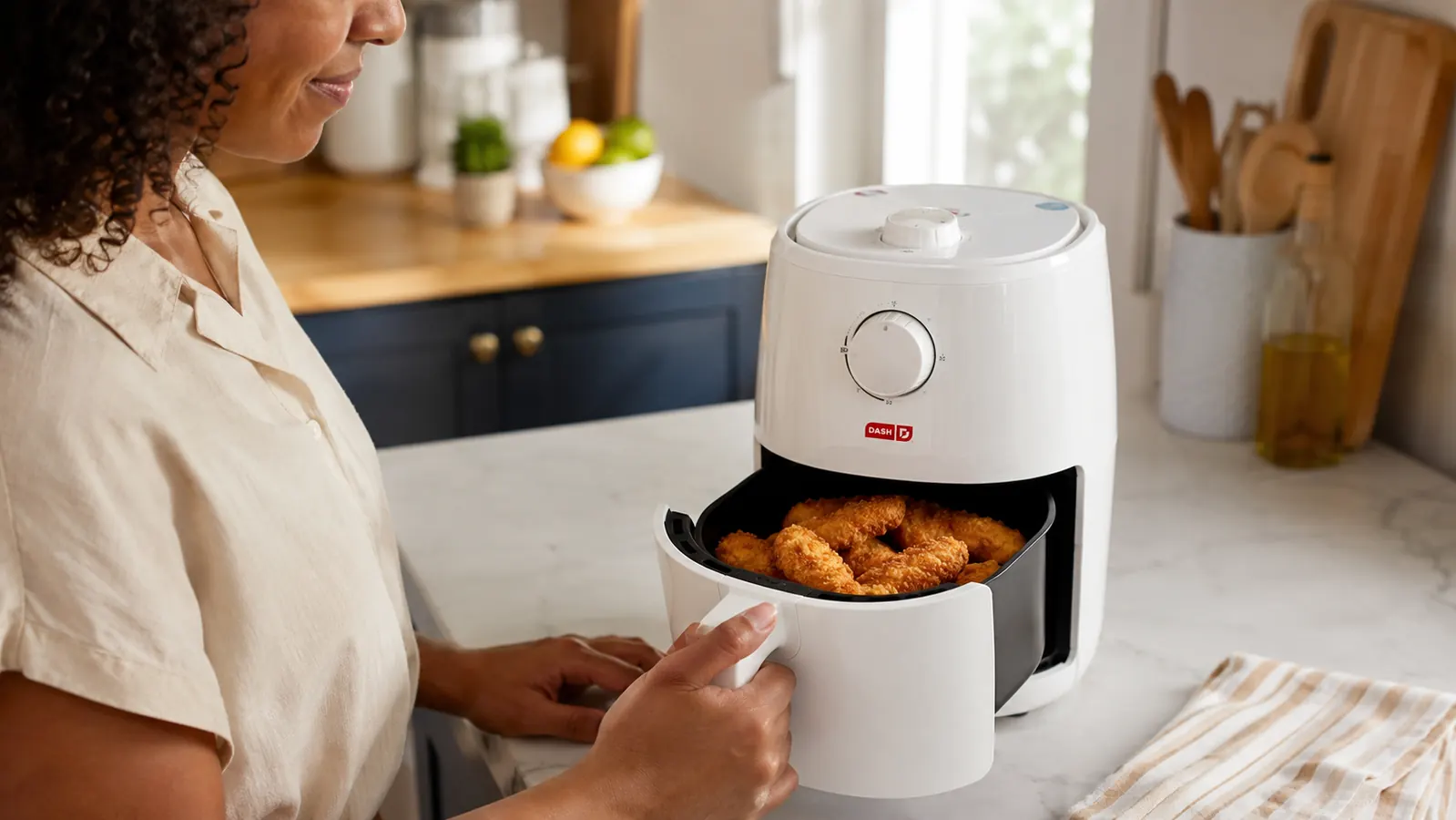
Where the Ninja Wins
The Ninja has a bigger basket. Four quarts versus 2.6 quarts is a meaningful difference if you're cooking for three or four people regularly, or if you want to do a full batch of wings in one go rather than two. I've cooked a pound of frozen chicken strips in the Dash and they fit, but they're more crowded than ideal. A single layer crisps better, and the Dash gets there faster at half portions.
The Ninja also runs at higher wattage, which means it's a bit more powerful and preheats to temperature faster in absolute terms. Its digital display is easier to read and set precisely than the Dash's analog dial, which some people find less intuitive. If you're someone who wants to dial in 375 degrees exactly for a specific recipe, the Ninja's digital controls make that easier. The Dash dial has notches but isn't labeled in 25-degree increments, so there's a small learning curve if you're precise about temperature.
The Ninja's 60-minute timer versus the Dash's 30-minute maximum is a real difference if you cook anything low and slow. For everyday air frying, nothing I make takes more than 20 minutes, so this has never mattered to me. But if you're dehydrating herbs or slow-roasting something, that extra time range matters.
The Ninja is a better machine in some measurable ways. But better for a kitchen that doesn't have room for it doesn't help. For most small-kitchen cooks, the Dash is the one that actually gets used.
Real-World Cooking Performance: What the Specs Don't Tell You
Both air fryers do the main job well. Frozen fries come out crispy. Chicken strips get golden. Reheated pizza doesn't get soggy. These are the things most of us actually use an air fryer for, and both machines pass that test without issue.
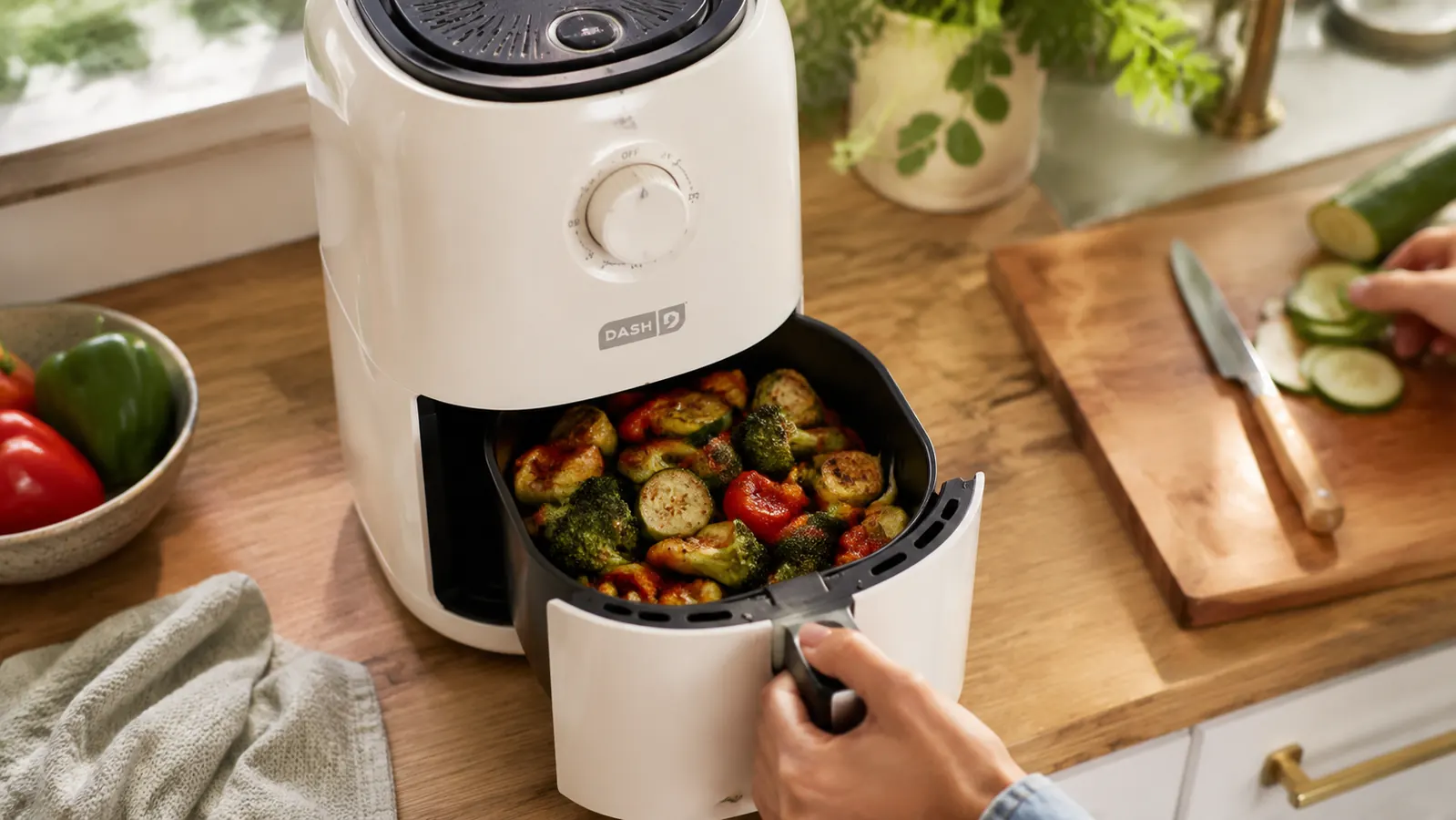
Where I noticed a difference was cooking from fresh rather than frozen. When I made fresh broccoli florets, the Dash crowded up faster than the Ninja. I had to shake the basket more often to get even results. With the Ninja's wider basket, I could spread the same amount in a single layer and get more consistent browning. If you cook a lot of fresh vegetables in batches, that difference in surface area is real.
On preheat: the Dash essentially has no preheat requirement. You set it and food goes in. The Ninja technically runs a short preheat cycle on some models, which adds a couple of minutes. In practice, this is minor, but the Dash wins on zero-hassle startup. When I'm getting dinner on the table in 20 minutes, every step that removes friction helps.
The Price Difference Spelled Out
For the Dash versus the Ninja, you're looking at a significant gap. That's a real amount of money. In my house, that difference is two weeks of lunches for one kid, or a month of a streaming service, or the difference between buying new and buying used on school supplies. I'm not saying the Ninja isn't worth it for some people. I'm saying you should be honest with yourself about what you're actually buying.
If you're buying the Ninja because it has a larger basket and you will use that larger basket regularly, that's a defensible purchase. If you're buying it because the digital display looks more premium or because it's a more recognizable brand name, you're paying a premium for packaging. The Dash has 34,000-plus Amazon reviews at 4.5 stars. It's not a compromise. It's the right tool for most compact kitchen situations.

Who Should Buy the Dash
The Dash is the right choice if you're cooking for one or two people most nights, your counter space is genuinely limited, you want something lightweight that you can move in and out of a cabinet easily, and budget is a factor. It's also the right pick if you're new to air frying and not sure how much you'll use it. At a low price point, the cost of trying it is low. If you use it every night for three months, you'll know it was worth the upgrade, and you can decide then whether to move up to something larger.
It handles frozen foods exceptionally well, it cleans up in under two minutes, and it takes up less than a square foot of counter space. For a family eating on a schedule in a small kitchen, this is the machine that gets used every day because it's never in the way and it's never a hassle to pull out.
If you want a deeper look at how the Dash holds up over months of daily use, I've written a full long-term review: Dash Air Fryer Review: 8 Months of Daily Use in a 400 Sq Ft Apartment.
Who Should Buy the Ninja
Go with the Ninja if you're cooking for three or four people regularly and need that larger basket to avoid cooking in shifts. It's also the better pick if you care about precise temperature control via a digital display, if you want a longer timer for low-and-slow cooking, or if you simply have the counter space and the budget and want the more capable machine.
The Ninja is a well-built air fryer. It's not overpriced for what it delivers. It's just delivering things that don't matter in every kitchen. If your kitchen situation matches what the Ninja offers, buy it without hesitation. But if you're trying to fit a compact appliance into a small space without overspending, the Ninja is more machine than you need.
Who Should Buy Which: The Short Answer
One to two people, small kitchen, tight budget: buy the Dash. You'll use it more because it's lighter, smaller, and cheaper. Three to four people, some counter room, willing to spend more: the Ninja's larger basket justifies the price. If you're still unsure which compact air fryer format makes sense for your kitchen, read 10 Reasons a Compact Air Fryer Is Worth It for a Small Kitchen for more context on what to look for, or check our honest Dash review to see the no-fluff breakdown on the budget pick.
If You Cook for 1-2 People and Have Less Than 3 Feet of Counter Space, the Dash Is the Smarter Buy. Check Today's Price
The Dash Tasti-Crisp 2.6-quart air fryer is Prime-eligible on Amazon with free returns. At this price, it's worth trying even if you're on the fence.
Amazon Check Today's Price on Amazon →