
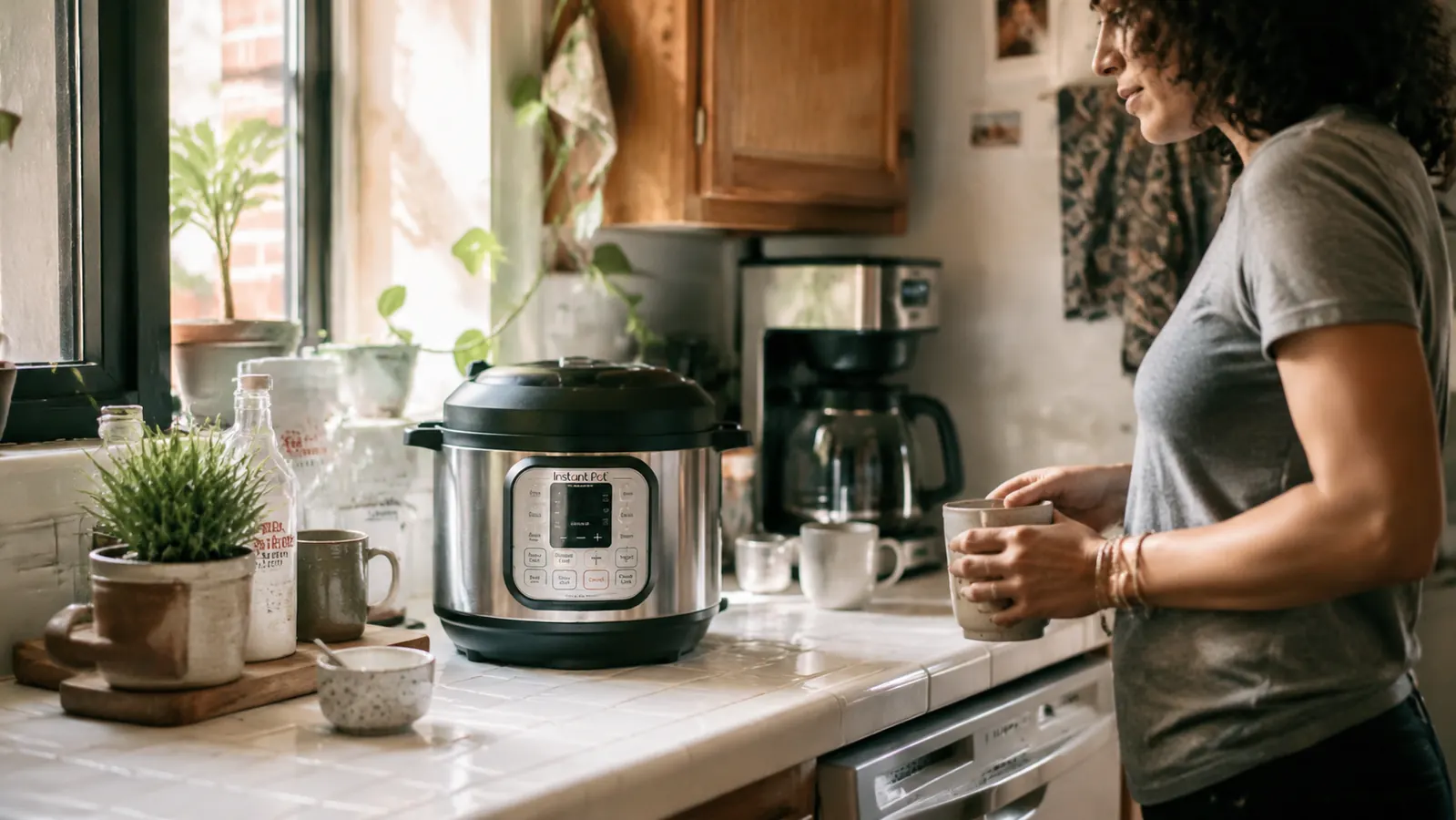
I bought the 6-quart Instant Pot first. I was convinced that bigger was smarter, that I would batch cook huge meals and freeze half, that I would somehow turn into a meal-prep person overnight. Six months later, that pot lived on top of my refrigerator because I had nowhere to put it and I never actually used it for the big batches I imagined. Then I got the 3-quart Mini. It has lived on my counter ever since. If you are cooking for one, two, or even three people in a small kitchen, the Instant Pot Duo Mini 3-Qt is almost certainly the right buy. But I want to actually show you the numbers and the tradeoffs so you can make that call with confidence instead of guessing.
This comparison is not about which Instant Pot is better in some abstract sense. They run the same seven functions, the same cooking programs, and the same safety system. What separates them is size, weight, counter footprint, and the realistic amount of food each one handles. Those four things should drive your decision entirely. Everything else is noise.
| Instant Pot Mini 3-Qt | 6-Qt | |
|---|---|---|
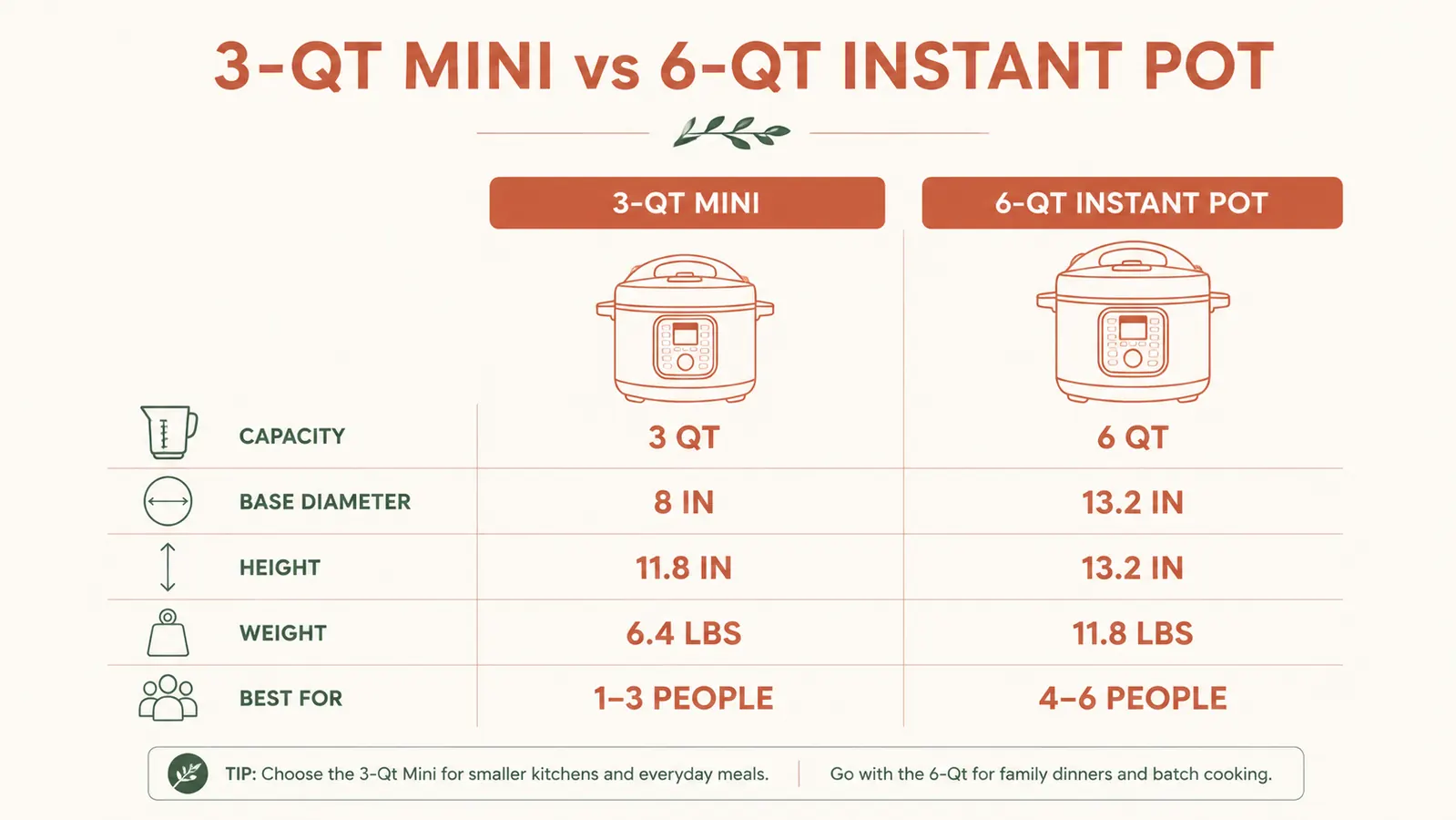
| Capacity | 3 quarts (fills to 2/3, so roughly 2 qt usable per batch) | 6 quarts (fills to 2/3, so roughly 4 qt usable per batch) |
| Base Diameter | Approx. 8 inches wide | Approx. 13.2 inches wide |
| Height | Approx. 11.8 inches (fits under most upper cabinets) | Approx. 13.2 inches (taller, needs cabinet clearance) |
| Weight | 6.4 lbs (one-handed lift into the sink) | 11.8 lbs (two-handed, typically stays on counter) |
| Price | Mid-range (check current price on Amazon) | Mid-range, varies by retailer |
| Best Household Size | 1 to 3 people | 4 to 6 people |
| Batch Cooking | Single-meal batches: soups, stews for 2-3 servings | Full-week meal prep, large roasts, whole chicken |
| Time to Pressure | Faster: less liquid and volume to pressurize | Slower: especially on full loads with more liquid |
| Storage Flexibility | Can tuck into a lower cabinet between uses | Typically counter-permanent; awkward to move in and out |
Where the 3-Qt Mini Wins
The Mini wins on the things that matter most for small kitchens: physical footprint and practical capacity matched to real household sizes. At roughly 8 inches wide at the base versus 13.2 inches for the 6-quart, the difference is not subtle on paper and it is even less subtle when you are trying to fit it on a counter shared with a coffee maker, a toaster, and a block of knives. I tested this myself. The Mini sits next to my coffee maker on a 24-inch stretch of counter without touching anything. The 6-quart I had previously required clearing everything else off first.
The weight difference also matters more than people expect. At 6.4 pounds, the Mini is light enough to lift one-handed into the sink for cleanup. The 6-quart at 11.8 pounds is a two-handed job every time, and that friction compounds across weeks of daily cooking. When something is annoying to clean, you use it less often. The Mini earns its counter spot by being genuinely easy to deal with after dinner when you are tired and just want to wash the thing and go sit down.
For households of one to three people, the Mini's usable capacity of roughly two quarts is plenty for most weeknight dinners. A full batch of chicken and rice for two people fits comfortably. A three-serving soup uses most of the pot without overfilling it. A cup of dried beans yields about three cups cooked, which is exactly what two people want. You do not end up with six servings of something that takes up the entire refrigerator and gets thrown out on Friday because nobody wanted it on Tuesday, Wednesday, or Thursday. That waste reduction is real money over the course of a year, and it is one of the strongest arguments for right-sizing your appliances to match your actual household instead of the household you imagine being someday.
The Mini also comes to pressure faster than the 6-quart. With less total liquid in the pot, the heating element reaches pressure in noticeably less time on most recipes. On a weeknight when dinner needs to happen in 30 minutes, that time-to-pressure gap matters. With the 6-quart, a full pot of soup might take 15 minutes just to reach pressure before the actual cook time begins. With the Mini at a smaller fill level, you might reach pressure in 8 minutes. Over a week of cooking, those minutes add up to a genuine difference in how long you are standing around waiting.
Where the 6-Qt Wins
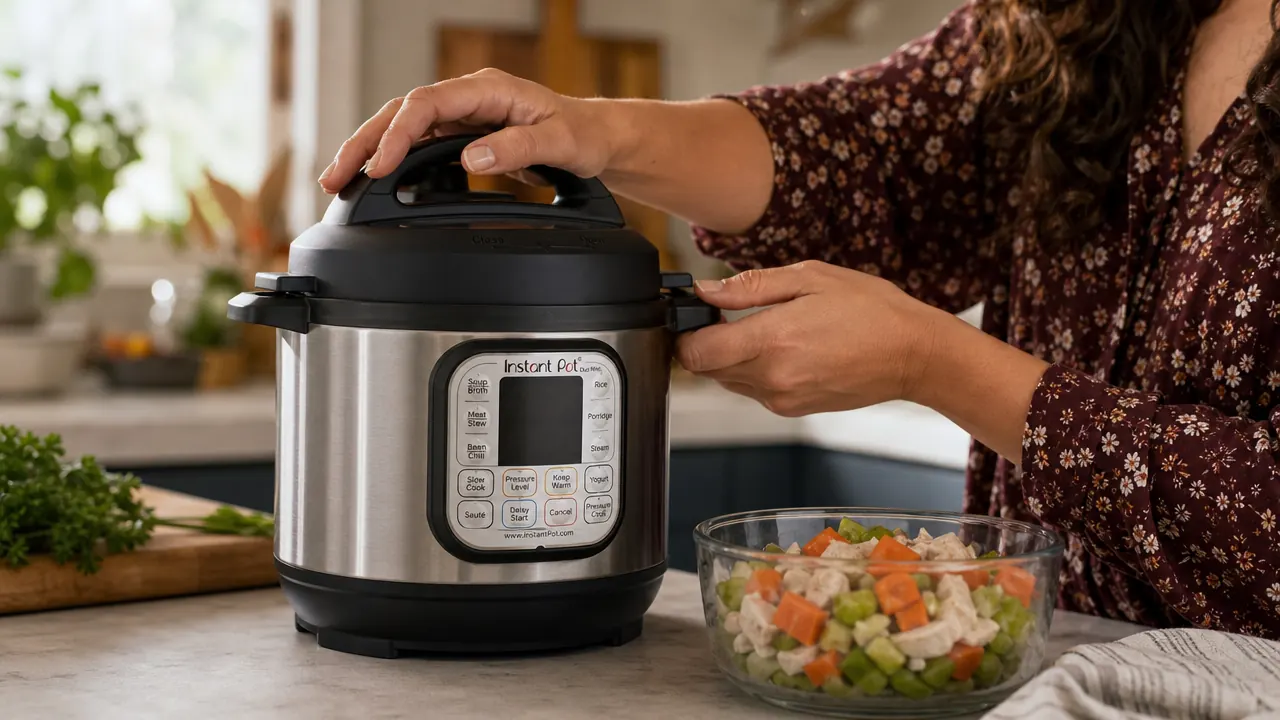
The 6-quart wins on one dimension: total volume. If you are cooking for four to six people every night, or if you genuinely batch cook on Sundays and want to fill containers for an entire week, the 6-quart is the right tool. It can hold a whole chicken. It can make a pot of chili that feeds six without you having to stand over the stove. It can handle bone broth in a quantity that makes the effort worthwhile. For a family of four or more, the Mini would feel limiting quickly, forcing you to run two batches of something where the 6-quart does it in one go.
The 6-quart also handles large cuts of meat better when those cuts need room to be fully submerged. A pork shoulder for pulled pork, a big beef brisket, or a whole rack of ribs bent to fit, these are situations where the Mini runs out of room. If those are part of your regular rotation and you are cooking for a table of five or six, the bigger pot pays for itself in convenience. For everything else, including soups, stews, grains, beans, eggs, and weeknight proteins for a smaller crew, the Mini handles it without any compromise.
You probably cook for two or three people. The Mini was built exactly for that.
The Instant Pot Duo Mini 3-Qt carries a 4.7-star rating across more than 184,000 reviews. It runs the same seven cooking programs as the full-size pot, fits on a small counter at just 8 inches wide, and weighs 6.4 lbs for easy cleanup. See today's price on Amazon before you decide.
Amazon Check Today's Price on Amazon →The Cooking Programs Are Identical on Both Sizes
One thing worth clarifying because I see this question come up constantly: the Mini runs the exact same seven cooking functions as the 6-quart. You get pressure cook, slow cook, rice cooker, steamer, saute, yogurt maker, and warming mode on both. The control panel looks the same. The buttons work the same. The safety mechanisms, the sealing ring, the float valve, and the anti-blockage vent are all identical between the two sizes. If you know how to use a 6-quart Instant Pot, you already know how to use the Mini. There is no learning curve difference whatsoever.
The only functional difference is what fits inside. And that comes back to household size and how much food you actually need at one time. With more than 184,000 reviews on Amazon sitting at 4.7 stars, the Mini is not some stripped-down compromise product. It is a fully capable pressure cooker that happens to fit where larger appliances do not.
Who Should Buy Which
Buy the 3-quart Mini if you live alone, with a partner, or with one child. Buy it if your kitchen counter is short on space and you need an appliance that earns its spot without taking over. Buy it if you cook mostly weeknight dinners for two or three people, and the idea of making six servings of soup just to eat it all week sounds like a chore rather than a strategy. Buy it if you have ever put a large appliance on top of your refrigerator and never taken it back down. Buy it if counter space is a real constraint and you want something that does not require rearranging everything else every time you want to use it.
Buy the 6-quart if you have four or more people eating dinner at your table most nights. Buy it if you genuinely meal prep on Sundays and want to cook eight to ten servings of something at once. Buy it if counter space is not a constraint, storage is not a problem, and you regularly cook whole chickens or large cuts of meat. Those are real situations where the bigger pot earns its size. But if you are on a site called Pick Small Kitchen, there is a decent chance the 3-quart is the honest answer for you.
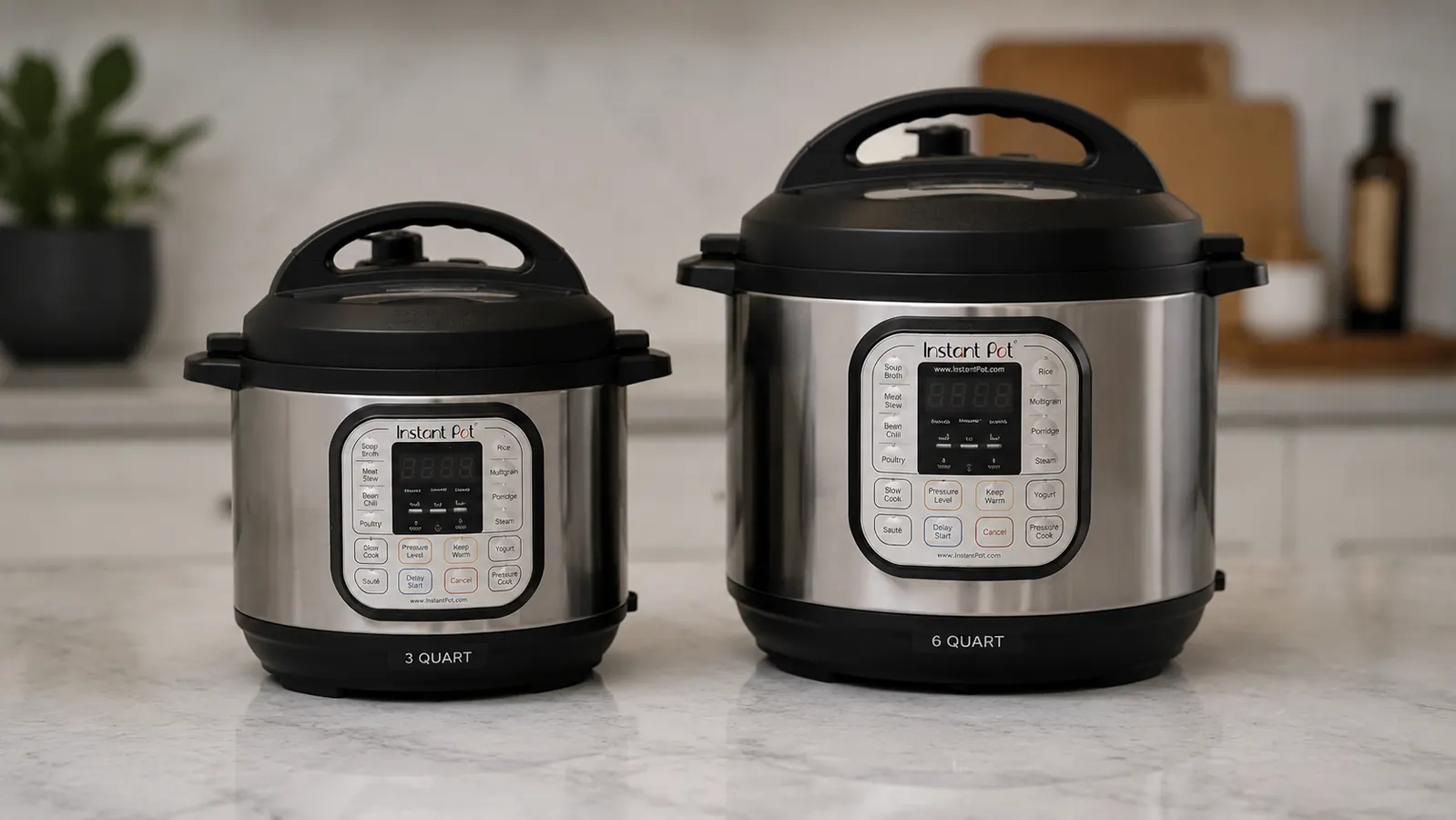
The 6-quart I owned lived on top of my refrigerator for six months. The Mini has sat on my counter ever since I brought it home. That tells you everything about right-sizing an appliance to your actual life, not your imagined one.
Accessories and Recipe Scaling: What to Know Before You Buy
One practical detail worth knowing upfront: the 3-quart Mini uses a different inner pot and lid size than the 6-quart, so accessories do not cross between the two sizes. If you buy a silicone lid, a steamer rack, or a tempered glass lid for the Mini, it will not fit the 6-quart, and vice versa. Both sizes have solid accessory options available on Amazon, but you have to shop specifically for your size. This is not a big deal once you know it, but it is annoying to discover after the fact.
Recipe scaling is the other thing to know. Most Instant Pot recipes circulating online are written for the 6-quart. When you cook with the Mini, you will often scale liquid and ingredient quantities down by about 30 to 50 percent, depending on the recipe. The minimum liquid requirement stays roughly the same at around one cup, so soups and stews scale down easily. Drier dishes like rice or grains need attention to the water ratio since you cannot just cut everything in half blindly. After two or three uses you get a feel for it and it stops feeling like extra math. But go in knowing it so your first experience with the Mini is not a failed batch of chicken broth.
For a full hands-on look at what the Mini is actually like to use over time, including what it does well and what catches first-time users off guard, read the year-long Instant Pot Duo Mini review. For the version that covers the frustrations most reviews skip over, the Instant Pot Duo Mini honest review is worth a read before you buy. And if you are still deciding whether a mini pressure cooker makes sense for apartment living at all, the 10 reasons the Instant Pot Mini is perfect for small apartments makes the full case.
The Bottom Line
For most people reading this, the Instant Pot Duo Mini 3-Qt is the right buy. It costs a little less than the 6-quart, takes up meaningfully less counter space, weighs half as much, and reaches pressure faster with smaller batches. For households of one to three people, it handles every realistic weeknight dinner without asking you to scale up recipes or manage leftovers you did not want. The 6-quart is a great appliance for a different situation, specifically for larger families with the counter space and storage to support it. If that is not your situation, do not let the idea of more capacity talk you into a pot that ends up sitting on top of your refrigerator collecting dust. Buy the one that fits the kitchen and the household you actually have.
The right size makes all the difference. Do not buy more pot than your kitchen and your household actually need.
The Instant Pot Duo Mini 3-Qt is rated 4.7 stars by more than 184,000 cooks. It replaces your slow cooker, rice cooker, steamer, saute pan, yogurt maker, and pressure cooker in one appliance that fits on a counter with room to spare. Check today's price on Amazon and see what is in stock.
Amazon Check Today's Price on Amazon →